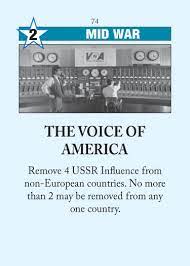
On February 17, 1947, the Voice of America (VOA), a United States government-funded international broadcaster, began transmitting its radio broadcasts to the Soviet Union. This historic event marked the beginning of a new era in the Cold War, as the United States sought to counter Soviet influence by providing an alternative source of news and information to the people living behind the Iron Curtain.

The establishment of the VOA's Russian-language broadcasts was part of a broader strategy known as "public diplomacy," aimed at promoting American values and ideals abroad. At a time when the Soviet Union tightly controlled the flow of information within its borders, the VOA represented a beacon of freedom and democracy, offering uncensored news, cultural programming, and commentary to listeners in the Soviet Union and beyond.

The timing of the VOA's launch was significant, coming just two years after the end of World War II and the beginning of the Cold War. Tensions between the United States and the Soviet Union were escalating rapidly, as the two superpowers vied for dominance on the world stage. The VOA's broadcasts were seen as a direct challenge to Soviet propaganda efforts, providing an alternative narrative to the one presented by the Kremlin.

From its inception, the VOA's Russian-language service aimed to provide accurate, objective, and reliable news and information to its audience. Its programming included news bulletins, feature stories, interviews, and cultural programs, covering a wide range of topics including politics, economics, culture, and society. The broadcasts were intended to not only inform but also to inspire and empower listeners, offering a glimpse of life outside the confines of Soviet censorship and control.

One of the key objectives of the VOA's Russian-language broadcasts was to counter Soviet propaganda and disinformation. The Soviet Union exerted tight control over the media within its borders, using propaganda to promote its own narrative and suppress dissenting voices. The VOA sought to provide an alternative perspective, offering listeners a more nuanced and balanced view of world events.

The impact of the VOA's Russian-language broadcasts was profound, reaching millions of listeners across the Soviet Union and beyond. Despite efforts by the Soviet government to jam the broadcasts and suppress access to foreign media, the VOA's signal managed to penetrate the Iron Curtain, reaching listeners in even the most remote corners of the Soviet Union. For many people living under Soviet rule, the VOA provided a lifeline to the outside world, offering hope and inspiration in the face of oppression.

Over the years, the VOA's Russian-language service evolved and adapted to changing geopolitical realities. With the collapse of the Soviet Union in 1991 and the end of the Cold War, the focus of the broadcasts shifted from countering communism to promoting democracy, human rights, and the rule of law in the newly independent states of the former Soviet bloc. Today, the VOA continues to broadcast in Russian and dozens of other languages, reaching audiences around the world with its message of freedom, democracy, and hope.