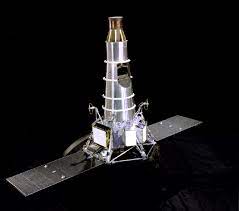
In the annals of space exploration, the year 1965 marked a significant milestone with the successful launch and mission of Ranger 8, an unmanned spacecraft tasked with capturing high-resolution images of the lunar surface. As part of NASA's Ranger program, Ranger 8 played a pivotal role in advancing scientific understanding of the Moon and paving the way for future crewed missions to Earth's nearest celestial neighbor.

The Ranger program was conceived in the late 1950s as a series of robotic missions aimed at achieving a variety of scientific objectives, including mapping the lunar surface, studying its composition, and assessing potential landing sites for crewed missions. The program represented a crucial precursor to the Apollo program, which ultimately landed astronauts on the Moon less than five years later.

Ranger 8 was the sixth in a series of Ranger spacecraft launched with the primary goal of transmitting detailed photographs of the lunar surface back to Earth. Equipped with six television cameras, the spacecraft was designed to capture images during its final descent to the Moon, providing unprecedented resolution and clarity compared to previous missions.

On February 17, 1965, Ranger 8 lifted off from Cape Canaveral, Florida, atop an Atlas-Agena B rocket, embarking on a trajectory that would take it on a collision course with the Moon. Over the course of its 64-hour journey, Ranger 8 executed a series of mid-course corrections to refine its trajectory and ensure a precise impact with the lunar surface.

As Ranger 8 approached the Moon, its cameras were activated, capturing a series of photographs with increasing detail and resolution. On February 20, 1965, the spacecraft successfully impacted the Moon's surface in the Sea of Tranquility, transmitting a trove of valuable data and images back to Earth in the moments leading up to its demise.

The images returned by Ranger 8 provided scientists with an unprecedented view of the lunar surface, revealing intricate details of craters, boulders, and other geological features with remarkable clarity. The spacecraft's final images, taken mere seconds before impact, offered a dramatic close-up of the lunar landscape, capturing the rugged terrain in stunning detail.

The success of Ranger 8 was a testament to the ingenuity and perseverance of the engineers and scientists involved in the mission. It demonstrated the feasibility of precision targeting and imaging techniques in the harsh environment of space, laying the groundwork for future lunar exploration missions.

The data and images returned by Ranger 8 proved invaluable to the planning and preparation of subsequent Apollo missions, providing crucial information about potential landing sites and surface conditions. Indeed, many of the photographs taken by Ranger 8 were used to identify suitable landing sites for the Apollo lunar landers, including the historic Apollo 11 mission that landed the first humans on the Moon in 1969.

In addition to its scientific achievements, Ranger 8 also served as a source of inspiration and wonder, captivating the imaginations of people around the world with its breathtaking images of the lunar surface. Its successful mission underscored the importance of robotic exploration in expanding our knowledge of the cosmos and paved the way for future exploration of the Moon and beyond.