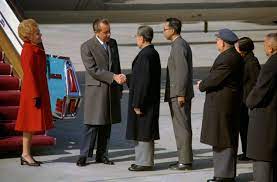
In February 1972, President Richard Nixon embarked on a historic journey to China, marking a significant turning point in the Cold War era and reshaping the geopolitical landscape. Nixon's visit, which lasted from February 21st to February 28th, was the first time a sitting U.S. president had visited the People's Republic of China, a country that had been isolated from the West for over two decades.

The trip was the culmination of a series of secret negotiations and diplomatic maneuvers orchestrated by Nixon and his National Security Advisor, Henry Kissinger. The decision to engage with Communist China was a bold and controversial move, given the long-standing hostility between the United States and the People's Republic of China, which had been established in 1949 following the Chinese Civil War.

At the time, China was viewed by many in the West as a pariah state, aligned with the Soviet Union in the global struggle against capitalism and democracy. The United States, on the other hand, had maintained diplomatic relations with Taiwan, viewing it as the legitimate government of China. However, Nixon saw an opportunity to exploit the growing rift between China and the Soviet Union to advance American interests.

Nixon's visit to China was shrouded in secrecy and carefully choreographed to maximize its impact on the international stage. The trip was preceded by months of behind-the-scenes negotiations between American and Chinese officials, facilitated by intermediaries such as Pakistan.

On February 21st, Nixon arrived in Beijing, where he was greeted with great ceremony by Chinese Premier Zhou Enlai. The visit included meetings with Chairman Mao Zedong, the iconic leader of the Chinese Communist Party, as well as other senior Chinese officials. Nixon's interactions with Mao and Zhou were carefully stage-managed for maximum propaganda effect, with both sides keen to portray the visit as a historic breakthrough in Sino-American relations.

During his stay in China, Nixon engaged in extensive discussions with Chinese leaders on a wide range of issues, including bilateral relations, regional security, and the ongoing conflict in Vietnam. The talks resulted in the Shanghai Communique, a joint statement issued by the United States and China on February 28th, outlining their shared commitment to normalizing relations and working towards a peaceful resolution of their differences.

The significance of Nixon's visit to China cannot be overstated. It marked the beginning of a new era in Sino-American relations, ending decades of hostility and paving the way for the establishment of formal diplomatic ties between the two countries. The rapprochement between the United States and China also had profound implications for the broader Cold War dynamic, as it effectively isolated the Soviet Union and contributed to the eventual collapse of communism in Eastern Europe.

In addition to its geopolitical ramifications, Nixon's visit to China had significant domestic implications. The trip was widely hailed as a diplomatic triumph, bolstering Nixon's reputation as a skilled statesman and providing a much-needed distraction from the ongoing Watergate scandal, which would ultimately lead to his resignation in 1974.

In conclusion, Nixon's historic visit to China in 1972 represented a bold and visionary move that reshaped the global balance of power and laid the groundwork for a new era of cooperation between East and West. Despite the initial skepticism and controversy surrounding the trip, its enduring legacy continues to shape international relations to this day.