ChatGPT
The year 1991 marked a pivotal moment in modern history with the United States engaging in a full-scale war with Iraq, known as the Gulf War or Operation Desert Storm. This conflict was a culmination of years of tension and geopolitical maneuvering in the Middle East, primarily centered around Iraq's invasion of Kuwait in August 1990.

The roots of the Gulf War can be traced back to Iraq's aggressive expansionist policies under the leadership of President Saddam Hussein. In August 1990, Iraqi forces invaded and annexed Kuwait, triggering international condemnation and alarm. The invasion threatened the stability of the region and raised concerns about Iraq's intentions towards its neighbors and the global oil supply.

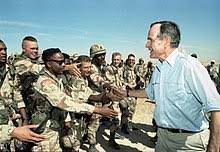
In response to the invasion, the United Nations Security Council passed a series of resolutions demanding Iraq's immediate and unconditional withdrawal from Kuwait. When diplomatic efforts to resolve the crisis peacefully failed, the United States, under the leadership of President George H.W. Bush, assembled a coalition of nations to confront Iraq militarily.

Operation Desert Storm commenced on January 17, 1991, with a massive aerial bombardment of Iraqi military targets. The coalition forces, led by the United States, deployed advanced weaponry and technology to cripple Iraq's air defenses and strategic infrastructure. The campaign aimed to degrade Iraq's ability to wage war and compel Saddam Hussein to comply with the UN resolutions.

The air campaign was followed by a ground invasion launched on February 24, 1991, with coalition forces launching a coordinated assault on Iraqi positions in Kuwait and southern Iraq. The ground offensive, characterized by swift and decisive maneuvers, quickly overwhelmed Iraqi defenses, leading to the liberation of Kuwait within a matter of days.

The Gulf War was a testament to the military superiority of the coalition forces, particularly the United States, which showcased its advanced weaponry, tactics, and logistical capabilities. The war also highlighted the growing role of technology in modern warfare, with precision-guided munitions and satellite imagery playing a crucial role in targeting and minimizing civilian casualties.

The conflict also had significant humanitarian implications, with reports of widespread destruction and human suffering in Iraq and Kuwait. The coalition forces faced criticism for the civilian casualties and environmental damage caused by their airstrikes, particularly the bombing of infrastructure such as power plants and water treatment facilities.

The Gulf War ended on February 28, 1991, with a ceasefire agreement brokered by the United Nations. Iraq agreed to comply with all UN resolutions, including the withdrawal of its forces from Kuwait and the dismantling of its weapons of mass destruction programs. The ceasefire also established a no-fly zone in southern Iraq to protect the Kurdish population from further persecution by the Iraqi regime.

Despite the military victory and the liberation of Kuwait, the Gulf War left unresolved issues and lingering tensions in the region. Saddam Hussein remained in power in Iraq, and the country faced years of economic sanctions and isolation from the international community. The war also had long-term consequences for the stability and security of the Middle East, setting the stage for future conflicts and upheavals in the region.