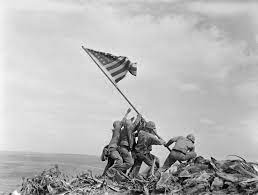
The raising of the United States flag atop Mount Suribachi on the island of Iwo Jima in 1945 stands as one of the most iconic and enduring images of World War II. This pivotal moment in history, captured in a photograph by Joe Rosenthal, symbolizes the courage, sacrifice, and resilience of American troops in the Pacific Theater.

Iwo Jima, a small volcanic island located 750 miles south of Tokyo, held immense strategic significance for both the Allied and Japanese forces. Its capture was deemed crucial for the advancement of the Allies towards mainland Japan. The Japanese, aware of its strategic importance, had heavily fortified the island with an intricate network of tunnels, bunkers, and artillery positions.

On February 19, 1945, the United States launched Operation Detachment, the amphibious assault on Iwo Jima. The battle that ensued would become one of the bloodiest and most fiercely contested of the Pacific campaign. The rugged terrain, coupled with the determined resistance of the Japanese defenders, resulted in intense and protracted fighting.

After days of bitter combat, on February 23, 1945, U.S. Marines reached the summit of Mount Suribachi, the highest point on the island. Amidst the chaos and carnage of battle, a small group of Marines, led by Lieutenant Harold G. Schrier, raised the American flag atop the mountain as a symbol of victory and triumph.

Joe Rosenthal, an Associated Press photographer, happened to be on the scene and captured the moment with his camera. His photograph, depicting the six Marines hoisting the flag against the backdrop of the Pacific Ocean and the volcanic terrain of Iwo Jima, would later become one of the most recognizable and reproduced images of the war.

The photograph, published in newspapers across the United States, quickly became a symbol of hope and determination for the American people. It captured the spirit of the Marines and their unwavering commitment to duty in the face of adversity. The image resonated deeply with the public, serving as a rallying cry for support of the war effort and a tribute to the sacrifices made by the brave men and women in uniform.

Despite the significance of the moment captured in Rosenthal's photograph, it is important to note that the raising of the first flag on Mount Suribachi was not the end of the battle for Iwo Jima. The fighting would continue for another month, with heavy casualties on both sides. However, the image of the flag-raising provided a much-needed morale boost for Allied forces and bolstered their resolve to press forward.

Tragically, three of the six Marines depicted in the photograph would later lose their lives in the ensuing battles on Iwo Jima. Their sacrifice, along with that of thousands of others who fought and died on the island, serves as a poignant reminder of the human cost of war.

The flag-raising on Mount Suribachi remains a symbol of courage, unity, and sacrifice. It serves as a testament to the bravery of the individuals who fought and died for their country and continues to inspire generations with its powerful message of resilience and determination in the face of adversity.