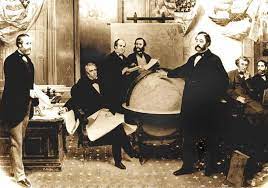
In 1867, the United States made a momentous decision to purchase Alaska from the Russian Empire in a landmark agreement known as the Alaska Purchase. This significant transaction, often dubbed "Seward's Folly" or "Seward's Icebox" after U.S. Secretary of State William H. Seward who negotiated the deal, marked a pivotal moment in American history and had far-reaching implications for the nation's territorial expansion, economic development, and strategic interests.

The purchase of Alaska from Russia for the sum of $7.2 million, equivalent to approximately two cents per acre, was initially met with skepticism and criticism in the United States. Many viewed the acquisition of the vast, sparsely populated territory as a wasteful and unnecessary expenditure, questioning the value and potential of a land perceived as remote, frozen, and uninhabitable.

However, the proponents of the Alaska Purchase saw the territory's strategic and economic potential, envisioning it as a gateway to the Pacific, a source of valuable natural resources, and a buffer against potential foreign threats. Russia's decision to sell Alaska to the United States was driven by a combination of economic considerations, geopolitical concerns, and the desire to divest itself of a distant and costly possession.

Upon the formal transfer of Alaska to the United States on October 18, 1867, the territory's new American administrators faced the challenges of governance, development, and integration into the growing nation. Alaska's vast size, harsh climate, and diverse indigenous populations posed unique challenges for the U.S. government as it sought to assert its authority, promote settlement, and exploit the territory's resources.

The discovery of gold in the late 19th century and the subsequent Klondike Gold Rush of the 1890s helped to transform Alaska's economy and attract settlers and prospectors to the region. The influx of new residents, the development of mining and fishing industries, and the construction of infrastructure such as railroads and ports contributed to Alaska's growth and prosperity.

The strategic importance of Alaska was further underscored during World War II when the territory served as a vital military outpost and supply route for the United States in the Pacific theater. The construction of military bases, airfields, and the Alaska Highway enhanced the territory's defense capabilities and solidified its role as a key component of America's national security strategy.

In the decades following the Alaska Purchase, the territory's natural resources, including timber, fish, oil, and minerals, played a crucial role in its economic development and contributed to its eventual statehood in 1959. Alaska's rich cultural heritage, stunning natural beauty, and unique wildlife also became sources of pride and identity for its residents and visitors alike.

The Alaska Purchase of 1867, once derided as a folly or mistake, ultimately proved to be a wise investment for the United States, opening up new opportunities for settlement, commerce, and strategic influence in the North Pacific. The acquisition of Alaska not only expanded America's territorial reach but also enriched its cultural tapestry, strengthened its economy, and secured its national defense interests in a critical region of the world.