In February 1945, one of the most pivotal battles of the Pacific Theater of World War II unfolded as United States Marines launched a daring assault on the Japanese-held island of Iwo Jima. This engagement would become etched in the annals of military history as one of the bloodiest and most iconic battles of the entire war. The landing on Iwo Jima marked a significant turning point, representing the relentless advance of Allied forces towards the Japanese homeland.

Strategically situated halfway between the Marianas Islands and the Japanese mainland, Iwo Jima held immense importance for both sides. For the Americans, capturing the island meant securing a vital airbase that would enable long-range bombing raids against Japan itself, significantly shortening the distance between American bombers and their targets. Conversely, the Japanese recognized the island's strategic value and were determined to defend it at all costs.

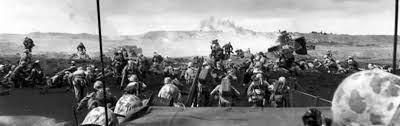
On February 19, 1945, Operation Detachment commenced with a massive amphibious assault. The initial landing involved tens of thousands of U.S. Marines storming the beaches under heavy fire from entrenched Japanese defenders. The black volcanic sands of Iwo Jima provided minimal cover, leaving the Marines vulnerable to relentless enemy fire from fortified positions on Mount Suribachi and across the island.

Despite facing fierce resistance, the Marines made incremental progress, inching their way forward with sheer determination and unwavering resolve. The battle soon devolved into a grueling and brutal slog, characterized by intense close-quarters combat and ferocious hand-to-hand fighting. Every inch of ground gained came at a staggering cost, as both sides endured unimaginable casualties.

One of the most iconic moments of the battle came on February 23, when a group of Marines reached the summit of Mount Suribachi and raised the American flag, an event immortalized in Joe Rosenthal's Pulitzer Prize-winning photograph. The image captured a symbol of hope and resilience amid the chaos of war, serving as a powerful emblem of American perseverance in the face of adversity.

However, the raising of the flag atop Mount Suribachi did not signal the end of the battle. The fighting on Iwo Jima raged on for another month, with the Marines engaged in relentless combat as they sought to secure the island and eliminate pockets of Japanese resistance. The Japanese defenders, deeply entrenched in a network of caves, bunkers, and tunnels, fought with fanatical determination, refusing to surrender despite the overwhelming odds against them.

The battle for Iwo Jima exacted a heavy toll on both sides. The Marines suffered over 6,800 killed in action and more than 19,000 wounded, while the Japanese incurred catastrophic losses, with only a few hundred of the island's defenders taken prisoner. The ferocity and scale of the fighting on Iwo Jima cemented its reputation as one of the bloodiest battles of the Pacific War.

Despite the high cost, the capture of Iwo Jima provided the Allies with a crucial strategic advantage. The island's airfields became instrumental in supporting the bombing campaign against Japan, playing a pivotal role in the eventual defeat of the Japanese Empire. The sacrifices made by the Marines on Iwo Jima would not be forgotten, their bravery and valor forever etched into the annals of military history.