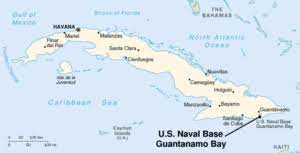
In 1903, the United States and Cuba entered into an agreement that would have far-reaching implications for both countries and the broader geopolitical landscape of the Western Hemisphere. This agreement, known as the Cuban-American Treaty, granted the United States a lease on the strategically located Guantanamo Bay, situated on the southeastern coast of Cuba. What began as a pragmatic arrangement for naval coaling and refueling purposes would eventually evolve into one of the most controversial and contentious issues in U.S.-Cuba relations.

Guantanamo Bay, with its deep natural harbor and strategic location at the entrance to the Caribbean Sea, had long been coveted by naval powers seeking to establish a foothold in the region. Recognizing its military significance, the United States seized control of Guantanamo Bay during the Spanish-American War of 1898, when American forces intervened in Cuba's struggle for independence from Spanish colonial rule.

Following the end of the war, the United States occupied Cuba and established military control over Guantanamo Bay. In 1903, under the terms of the Cuban-American Treaty, the U.S. secured a lease on the bay, granting the American government exclusive jurisdiction and control over the area for the purpose of establishing a naval station and coaling station.

The lease agreement stipulated that Guantanamo Bay would be used exclusively for naval and coaling purposes, with the United States paying an annual rent to the Cuban government. However, the terms of the lease also granted the United States significant autonomy and control over the territory, including the right to administer justice and maintain order within the naval station.

Over the years, Guantanamo Bay would become a key strategic asset for the United States, serving as a vital outpost for projecting American power and influence in the Caribbean and Latin America. During times of conflict, such as the Spanish-American War and World War II, Guantanamo Bay played a crucial role as a naval base and staging area for military operations.

However, the status of Guantanamo Bay would become increasingly controversial in the decades that followed, as questions arose about the legality and morality of the U.S. presence on Cuban soil. The Cuban government, led by Fidel Castro following the Cuban Revolution of 1959, repeatedly called for the return of Guantanamo Bay to Cuban sovereignty, denouncing the U.S. presence on the island as a violation of Cuban sovereignty and an affront to international law.

The issue of Guantanamo Bay gained renewed attention in the early 21st century, following the September 11, 2001, terrorist attacks on the United States. In the aftermath of the attacks, the U.S. government established a detention facility at Guantanamo Bay to hold individuals captured in the "war on terror," many of whom were deemed "enemy combatants" and held without charge or trial.

The Guantanamo Bay detention camp, often referred to as "Gitmo," became the subject of widespread criticism and condemnation from human rights organizations and the international community, who raised concerns about the treatment of detainees and the lack of due process rights afforded to them.

Despite calls for its closure, the Guantanamo Bay detention camp remains operational to this day, serving as a stark reminder of the complex and contentious legacy of the U.S. presence in Guantanamo Bay. The issue continues to be a source of tension in U.S.-Cuba relations and a focal point for debates about national security, human rights, and the rule of law.