On February 24, 1991, a pivotal moment occurred in the Persian Gulf War when the United States-led coalition launched a ground invasion into Kuwait, marking the beginning of the campaign to liberate the tiny Gulf nation from Iraqi occupation. This operation, known as Operation Desert Sabre, represented the culmination of weeks of intense air and naval bombardment and signaled a decisive shift in the conflict.

The Persian Gulf War, also known as Operation Desert Storm, was triggered by Iraq's invasion and annexation of Kuwait on August 2, 1990. The Iraqi invasion, led by Saddam Hussein, provoked international condemnation and triggered a swift and forceful response from the United States and its allies, who viewed the aggression as a threat to regional stability and global security.

In the months leading up to the ground invasion, coalition forces, led by the United States, launched a massive air campaign aimed at crippling Iraq's military capabilities and weakening its grip on Kuwait. Operation Desert Storm saw relentless airstrikes targeting Iraqi military installations, communication networks, and key infrastructure across the country. The bombardment, conducted with unprecedented precision and coordination, inflicted heavy damage on Iraqi forces and laid the groundwork for the ground offensive to come.

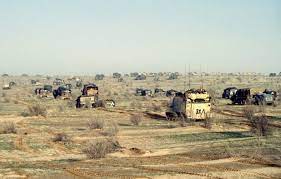
On February 24, 1991, coalition ground forces launched a coordinated assault into Kuwait, spearheaded by the U.S. Army's VII Corps and the U.S. Marine Corps. The ground invasion, which unfolded along multiple axes of advance, aimed to drive Iraqi forces out of Kuwait and restore its sovereignty.

The coalition forces encountered stiff resistance from Iraqi troops, who had fortified their positions and laid extensive minefields and defensive barriers across the Kuwaiti desert. Despite facing daunting challenges, coalition forces pressed forward with determination and resolve, supported by overwhelming air and artillery support.

The ground offensive was characterized by a combination of armored thrusts, mechanized infantry assaults, and airborne operations, as coalition forces sought to outmaneuver and overwhelm Iraqi defenses. The U.S. Army's armored divisions, equipped with cutting-edge tanks and armored vehicles, spearheaded the advance, while Marine Corps units conducted amphibious assaults along the Kuwaiti coastline.

The battle for Kuwait was fierce and intense, with coalition forces engaging in intense combat with Iraqi troops in urban centers, desert plains, and along key strategic routes. The Iraqi military, though outnumbered and outgunned, put up a determined defense, fighting fiercely to hold onto Kuwaiti territory.

Despite the challenges, coalition forces achieved significant successes on the battlefield, rapidly advancing into Kuwait and inflicting heavy losses on Iraqi forces. Within days, coalition troops had liberated Kuwait City and driven Iraqi forces into retreat, marking a decisive turning point in the conflict.

By the end of February 1991, the ground invasion had achieved its objectives, effectively ending Iraq's occupation of Kuwait and restoring its sovereignty. The success of Operation Desert Sabre demonstrated the overwhelming military superiority of the coalition forces and underscored the effectiveness of combined arms warfare in modern conflict.

The liberation of Kuwait represented a significant victory for the United States and its allies, reaffirming their commitment to upholding international law and preserving regional stability in the face of aggression. However, the Persian Gulf War would have far-reaching consequences, shaping the geopolitical landscape of the Middle East and setting the stage for future conflicts in the region.