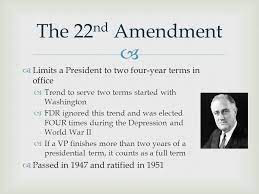
The 22nd Amendment to the United States Constitution, ratified on February 27, 1951, imposed term limits on the presidency, fundamentally altering the landscape of American politics. This amendment was a direct response to the unprecedented four-term presidency of Franklin D. Roosevelt, who served as president from 1933 until his death in 1945. The passage of the 22nd Amendment was a reflection of the nation's concerns about the concentration of power in the executive branch and the potential for abuse of that power.

The 22nd Amendment states that "No person shall be elected to the office of the President more than twice, and no person who has held the office of President, or acted as President, for more than two years of a term to which some other person was elected President shall be elected to the office of the President more than once." This amendment effectively limited presidents to serving a maximum of two terms in office, ensuring that no individual could hold the presidency indefinitely.

The push for the 22nd Amendment gained momentum in the aftermath of Roosevelt's presidency, as many Americans and lawmakers expressed concerns about the potential for a president to amass unchecked power over an extended period. Critics of Roosevelt's multiple terms in office argued that the presidency was never intended to become a lifelong position and that term limits were necessary to prevent the emergence of a dictatorship or authoritarian regime.

The 22nd Amendment was supported by a broad coalition of lawmakers from both major political parties, reflecting a bipartisan consensus on the need for presidential term limits. The amendment was ultimately ratified by the required number of states and became enshrined in the Constitution, setting a new precedent for the democratic governance of the United States.

The impact of the 22nd Amendment on American politics was profound. The introduction of term limits for the presidency brought a sense of accountability and rotation of power to the highest office in the land. Presidents were now required to govern with the knowledge that their time in office was limited, encouraging them to focus on achieving their policy goals within a finite timeframe and ensuring a regular turnover of leadership.

The 22nd Amendment also had implications for the way presidential campaigns were conducted. With the knowledge that they could only serve two terms, presidents were more likely to prioritize their policy agenda and legacy during their time in office. This shift in focus led to a renewed emphasis on achieving meaningful and lasting change during a president's tenure, rather than on securing re-election at all costs.

Overall, the 22nd Amendment to the United States Constitution represented a significant milestone in the evolution of American democracy. By imposing term limits on the presidency, the amendment sought to prevent the concentration of power in the executive branch and uphold the principles of democratic governance. The legacy of the 22nd Amendment continues to shape American politics to this day, ensuring that the presidency remains a position of public service rather than personal ambition.