The end of the 1991 Gulf War marked a significant turning point in modern history, bringing closure to a conflict that had far-reaching implications for the Middle East and the world at large. The war, which began with the Iraqi invasion of Kuwait on August 2, 1990, culminated in a swift and decisive military campaign led by a coalition of nations, primarily the United States, against Saddam Hussein's regime in Iraq.

The Gulf War was triggered by Iraq's aggressive expansionist policies, as Saddam Hussein sought to annex Kuwait and control its vast oil reserves. The international community, alarmed by Iraq's actions and fearing destabilization in the region, swiftly condemned the invasion and called for Iraq's immediate withdrawal from Kuwait.

Diplomatic efforts to resolve the crisis peacefully proved unsuccessful, leading to the authorization of military action by the United Nations Security Council. Operation Desert Storm, as it was codenamed, commenced on January 17, 1991, with a massive aerial bombardment followed by a ground offensive aimed at liberating Kuwait from Iraqi occupation.

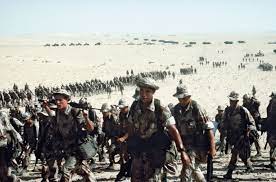
Led by General Norman Schwarzkopf, the coalition forces quickly gained the upper hand, employing advanced weaponry and overwhelming firepower to swiftly neutralize Iraqi defenses. The war was characterized by precision airstrikes targeting strategic military installations, as well as ground operations aimed at pushing Iraqi forces out of Kuwaiti territory.

The ground offensive, launched on February 24, 1991, proved to be a decisive blow to Iraqi forces, who were overwhelmed by the superior firepower and tactical prowess of the coalition troops. Within a matter of days, Kuwait was liberated, and Iraqi forces were routed from the country, leading to a swift and decisive victory for the coalition.

The end of the Gulf War was formally declared on February 28, 1991, when a ceasefire agreement was brokered between the coalition and Iraq. The terms of the ceasefire, outlined in United Nations Security Council Resolution 687, mandated the withdrawal of Iraqi forces from Kuwait, the destruction of Iraq's weapons of mass destruction, and the establishment of a no-fly zone over Iraq to prevent further aggression.

The ceasefire marked the beginning of a new chapter in the Middle East, as the region grappled with the aftermath of the war and its long-term implications. While the liberation of Kuwait was widely hailed as a triumph of international cooperation and collective security, the Gulf War also left behind a legacy of unresolved issues and simmering tensions.

One of the most contentious legacies of the Gulf War was the imposition of harsh economic sanctions on Iraq, which had a devastating impact on the country's civilian population. The sanctions, coupled with Saddam Hussein's brutal regime, led to widespread suffering and deprivation, fueling resentment and anti-Western sentiment in Iraq.

Moreover, the Gulf War set the stage for subsequent conflicts and instability in the region, including the 2003 invasion of Iraq and the rise of extremist groups such as ISIS. The war also underscored the complex geopolitical dynamics of the Middle East, highlighting the enduring tensions between regional powers and the role of external actors in shaping the region's destiny.