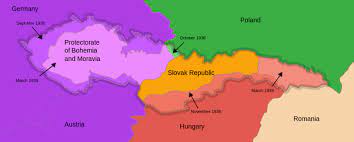
In 1939, Czechoslovakia, a democratic and multi-ethnic state in Central Europe, faced a tragic and tumultuous chapter in its history when it was dissolved as a result of external aggression, political betrayal, and international appeasement. The dissolution of Czechoslovakia in 1939 marked a dark turning point in the country's fate and had far-reaching consequences for the region, Europe, and the world at large.

The events leading to the dissolution of Czechoslovakia can be traced back to the Munich Agreement of 1938, a controversial pact signed by Germany, Italy, France, and Britain that allowed Nazi Germany to annex the Sudetenland, a predominantly German-speaking region of Czechoslovakia. The Munich Agreement, hailed as a diplomatic triumph for avoiding war and appeasing Hitler's territorial ambitions, effectively dismembered Czechoslovakia and weakened its ability to defend its sovereignty and territorial integrity.

Following the Munich Agreement, Czechoslovakia found itself isolated and vulnerable, with its borders exposed and its political unity shattered. In March 1939, in a blatant act of aggression and betrayal, Nazi Germany violated the Munich Agreement and occupied the remaining Czech territories, effectively dismantling the Czechoslovak state and establishing a puppet regime in Slovakia. The dissolution of Czechoslovakia was met with international condemnation and outrage, as the world witnessed the tragic consequences of appeasement, aggression, and the erosion of democratic values and principles.

The dissolution of Czechoslovakia in 1939 had profound implications for the Czech and Slovak peoples, who were forcibly separated and subjected to foreign occupation and oppression. The Czechs and Slovaks, who had coexisted peacefully and cooperatively in a shared state for two decades, were now divided along ethnic, linguistic, and political lines, as the Nazis sought to exploit and manipulate their differences to further their imperial ambitions and racial ideologies.

The dissolution of Czechoslovakia also had broader geopolitical implications, as it signaled the beginning of a new phase of aggression and expansionism by Nazi Germany, which would ultimately lead to the outbreak of World War II. The dismemberment of Czechoslovakia served as a stark warning of the dangers of appeasement, the consequences of territorial aggression, and the fragility of international order and security in the face of totalitarian regimes and imperial ambitions.

In the aftermath of the dissolution of Czechoslovakia, the Czech and Slovak peoples faced a period of uncertainty, fear, and resistance as they struggled to come to terms with the loss of their independence and the imposition of foreign rule. The Nazi occupation of Czechoslovakia brought with it repression, persecution, and violence against political opponents, ethnic minorities, and dissenting voices, as the regime sought to crush resistance and impose its brutal rule on the occupied territories.

Despite the dissolution of Czechoslovakia and the hardships endured by its people during the Nazi occupation, the spirit of resistance, resilience, and solidarity continued to inspire acts of courage, defiance, and sacrifice among the Czechs and Slovaks. The underground resistance movements, partisan groups, and individuals who risked their lives to oppose the occupiers and uphold the values of freedom, democracy, and national sovereignty became symbols of hope and heroism in the face of adversity and oppression.