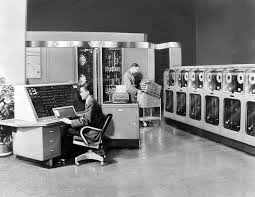
In 1951, the United States witnessed a groundbreaking development in the field of computing with the introduction of the UNIVAC (Universal Automatic Computer). The UNIVAC represented a significant leap forward in technology, marking the dawn of the computer age and revolutionizing data processing, scientific research, business operations, and government functions. The creation and deployment of the UNIVAC marked a pivotal moment in American history and laid the foundation for the modern digital era.

Developed by engineers J. Presper Eckert and John Mauchly, the UNIVAC was the first commercially available computer in the United States and one of the earliest electronic digital computers in the world. The UNIVAC was designed to perform a wide range of computing tasks, including data analysis, calculations, and information processing, with unprecedented speed and accuracy compared to earlier mechanical and electromechanical systems.

The UNIVAC's innovative design and capabilities set it apart from its predecessors, with its use of vacuum tubes for processing, magnetic tape for storage, and a sophisticated electronic architecture that enabled it to handle complex computations and large volumes of data. The UNIVAC's introduction marked a major technological advancement that paved the way for future generations of computers and laid the groundwork for the digital revolution that would transform society in the decades to come.

One of the most notable early applications of the UNIVAC was its use in the 1952 presidential election, where it made history by successfully predicting the outcome of the race between Dwight D. Eisenhower and Adlai Stevenson. The UNIVAC's accurate forecast of the election results, based on early returns and statistical analysis, demonstrated the power and potential of computer technology in predicting and processing vast amounts of data in real-time.

The success of the UNIVAC in the 1952 election helped to showcase the capabilities of computer technology and raise awareness of its potential applications in diverse fields, including business, science, engineering, and government. The UNIVAC's speed, accuracy, and reliability made it a valuable tool for processing information, analyzing data, and solving complex problems that were beyond the capacity of human operators or earlier computing machines.

The introduction of the UNIVAC in 1951 marked a turning point in the history of computing, signaling the shift from manual and mechanical methods of data processing to electronic and digital systems that could perform tasks with unprecedented efficiency and precision. The UNIVAC's impact on American society was profound, influencing the development of new industries, transforming the way organizations operated, and accelerating the pace of technological innovation across various sectors.

The UNIVAC's legacy endured long after its initial introduction, inspiring a new generation of computer scientists, engineers, and innovators to push the boundaries of computing technology and explore the possibilities of artificial intelligence, machine learning, and data analytics. The UNIVAC's pioneering role in the evolution of computing laid the foundation for the digital age and shaped the trajectory of technological progress in the United States and around the world.