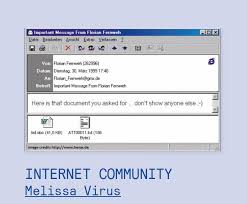
In 1999, the "Melissa" email virus emerged as one of the most notorious computer viruses in the history of the internet, causing widespread disruption, damage, and alarm among individuals, businesses, and organizations in the United States and around the world. The Melissa virus, named after a stripper in Florida, was a self-replicating computer worm that spread rapidly through email systems, infecting millions of computers and causing significant economic and operational consequences.

The Melissa virus was created by David L. Smith, a computer programmer from New Jersey, who designed the malicious code to exploit vulnerabilities in Microsoft Word and Outlook email software. The virus was distributed as an infected Microsoft Word document attached to an email with the subject line "Here is that document you asked for... don't show anyone else ;-)" The lure of the seemingly innocuous email message enticed recipients to open the attachment, unknowingly triggering the activation and spread of the virus.

Once opened, the Melissa virus would infect the recipient's computer and replicate itself by sending copies of the infected email to the first 50 contacts in the recipient's address book. This rapid and automated dissemination method allowed the virus to propagate quickly and overwhelm email servers and networks with a deluge of infected messages, causing email systems to crash, slow down, or become unresponsive.

The impact of the Melissa virus was felt across a wide range of sectors, including government agencies, corporations, educational institutions, and individuals who relied on email for communication, collaboration, and business operations. The virus spread like wildfire, infecting millions of computers within hours and causing email servers to become clogged with infected messages, disrupting normal email traffic and impeding the ability of users to send and receive messages.

The Melissa virus also had significant economic consequences, with estimates of the financial damage caused by the virus reaching into the tens of millions of dollars. Businesses and organizations experienced lost productivity, downtime, and IT costs associated with cleaning infected systems, restoring data, and implementing security measures to prevent future infections. The widespread disruption caused by the Melissa virus highlighted the vulnerability of digital systems to malicious attacks and underscored the need for improved cybersecurity measures and awareness among users.

In response to the Melissa virus outbreak, antivirus companies, cybersecurity experts, and law enforcement agencies mobilized to contain the spread of the virus, develop detection and removal tools, and track down the perpetrators responsible for creating and disseminating the malicious code. David L. Smith, the creator of the Melissa virus, was eventually apprehended, prosecuted, and sentenced to prison for his role in unleashing the destructive computer worm on the internet.

The Melissa virus outbreak in 1999 served as a wake-up call for the cybersecurity community, prompting a renewed focus on the development of antivirus software, email security protocols, and user education programs to mitigate the risk of future virus outbreaks and protect digital systems from cyber threats. The lessons learned from the Melissa virus incident helped to shape the evolution of cybersecurity practices, policies, and technologies in the years that followed, leading to greater awareness, vigilance, and resilience in the face of evolving cyber threats.