The year 2009 was marked by significant turmoil in the financial markets, particularly in the United States, as the country grappled with the aftermath of the global financial crisis that began in 2008. One of the most striking indicators of this economic upheaval was the precipitous decline in U.S. shares, which reached their lowest levels in twelve years, reflecting widespread uncertainty and investor panic.

The roots of the financial crisis can be traced back to the bursting of the U.S. housing bubble, which led to a cascade of events that reverberated throughout the global economy. Risky lending practices, fueled by a belief in perpetual housing price appreciation, resulted in a proliferation of subprime mortgages and complex financial instruments that spread risk throughout the financial system. When housing prices began to decline and borrowers defaulted on their loans, the consequences were felt far and wide.

In the wake of the crisis, financial institutions teetered on the brink of collapse, leading to government interventions such as bailouts and stimulus measures aimed at stabilizing the economy. The stock market, a barometer of investor confidence and economic health, bore the brunt of the turmoil, experiencing sharp declines as investors panicked and sought to unload their assets.

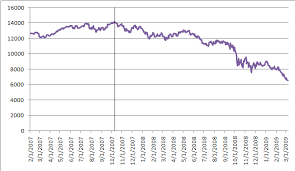
The Dow Jones Industrial Average (DJIA), a key index of U.S. stock market performance, plummeted to its lowest level in twelve years in March 2009, dipping below the 6,600 mark. This represented a stark contrast to the heady days of the late 1990s and early 2000s when the stock market experienced a historic bull run fueled by the dot-com boom.

The sharp decline in U.S. shares reflected the pervasive sense of fear and uncertainty gripping the financial markets. Investor confidence had been shattered, and many were unsure of how deep the economic downturn would be or how long it would last. The banking sector, in particular, was under intense scrutiny as concerns mounted about the solvency of major financial institutions.

In response to the crisis, policymakers implemented a series of measures aimed at restoring stability to the financial system and stimulating economic growth. The Federal Reserve slashed interest rates to historic lows and embarked on a program of quantitative easing, injecting liquidity into the economy by purchasing government securities and mortgage-backed securities.

The U.S. government also enacted fiscal stimulus packages aimed at boosting consumer spending and shoring up key sectors of the economy. These efforts, combined with aggressive monetary policy, eventually helped to stabilize the financial markets and pave the way for a gradual recovery.

By the end of 2009, signs of improvement were beginning to emerge. The stock market had rebounded from its lows, and economic indicators suggested that the worst of the recession may have passed. However, the road to recovery would prove to be long and challenging, with lingering effects of the financial crisis continuing to be felt for years to come.

The crisis of 2008-2009 served as a stark reminder of the interconnectedness of the global economy and the risks inherent in financial markets. It prompted a reevaluation of regulatory frameworks and risk management practices aimed at preventing future crises. While the stock market eventually recovered from its lows, the scars of the financial crisis would leave a lasting impact on the U.S. economy and shape the trajectory of financial markets for years to come.