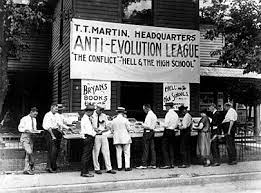
In 1925, the state of Tennessee in the United States passed a controversial piece of legislation known as the Butler Act, which prohibited the teaching of the theory of evolution in public schools. The Butler Act, named after Tennessee state representative John Washington Butler, reflected the growing tensions between science and religion, as well as the broader cultural and social conflicts that characterized the early 20th century in America.

The Butler Act was a response to the increasing influence of modern scientific theories, particularly Charles Darwin's theory of evolution by natural selection, which challenged traditional religious beliefs about the origins of life and the nature of humanity. Advocates of the Butler Act argued that the teaching of evolution in schools was incompatible with the biblical account of creation and undermined the moral and spiritual values that were central to American society.

The passage of the Butler Act in Tennessee sparked a national debate over the role of science, religion, and education in shaping the minds and beliefs of future generations. Proponents of the act, often aligned with conservative religious groups and fundamentalist Christians, viewed evolution as a dangerous and subversive idea that threatened the moral fabric of society and eroded faith in God and divine creation.

Opponents of the Butler Act, including educators, scientists, and advocates for academic freedom, argued that the legislation represented an infringement on the principles of free speech, intellectual inquiry, and scientific progress. They contended that the teaching of evolution was essential for a comprehensive and rigorous education in biology and the natural sciences, and that efforts to suppress or censor scientific knowledge were antithetical to the values of academic freedom and intellectual integrity.

The Butler Act gained national attention and controversy when it was used as the legal basis for the prosecution of high school science teacher John T. Scopes in what became known as the Scopes Monkey Trial. In 1925, John Scopes was charged with violating the Butler Act by teaching evolution in his classroom, in defiance of the state law that prohibited such instruction. The trial, which pitted renowned lawyer Clarence Darrow against fundamentalist leader William Jennings Bryan, became a symbolic battle between science and religion, reason and faith, progress and tradition.

The Scopes Monkey Trial captivated the nation and drew widespread media coverage, as it exposed the deep divisions and conflicts within American society over issues of religion, education, and the role of government in regulating intellectual discourse. The trial also highlighted the tensions between rural and urban values, conservative and progressive ideologies, and traditionalism and modernity that characterized the cultural landscape of the 1920s.

In the end, John Scopes was found guilty of violating the Butler Act and fined $100, although the verdict was later overturned on a technicality. The Scopes Monkey Trial did not resolve the fundamental questions at the heart of the evolution controversy, but it did raise awareness of the importance of academic freedom, scientific literacy, and critical thinking in the education system, and underscored the need for a balanced and inclusive approach to teaching controversial topics in schools.

The legacy of the Butler Act and the Scopes Monkey Trial continues to resonate in debates over science education, religious freedom, and the separation of church and state in American society. The clash between evolution and creationism, reason and faith, science and religion, remains a perennial issue that reflects deeper tensions and conflicts over the nature of knowledge, truth, and belief in a diverse and pluralistic society. The Butler Act serves as a cautionary reminder of the dangers of censorship, dogma, and intolerance in shaping public discourse and educational policy, and the enduring struggle to reconcile competing worldviews and values in the pursuit of knowledge and understanding.